🌐 Project 03: Network Security & Traffic Control
Segmentation, Access Boundaries, and Controlled Traffic Flow




🎯 Objective
Design and implement a segmented and secure network architecture that enforces controlled communication between resources.
This project demonstrates how network design, traffic control, and security rules act as an extension of identity and access management, ensuring that systems can only communicate where explicitly permitted.
🧠 Design Rationale
The architecture is built around controlling access through network boundaries:
- Segmentation: Isolating workloads into separate subnets
- Controlled Communication: Allowing only required traffic paths
- Traffic Governance: Forcing traffic through defined routes
- Defence in Depth: Combining network and identity controls
This reflects a move from flat, open networks to Zero Trust-aligned infrastructure.
🔐 IAM & Security Alignment
This implementation supports key IAM principles:
- Least Privilege (Network Level): Only required ports and sources are allowed
- Access Boundaries: Network segmentation restricts lateral movement
- Policy Enforcement: Traffic rules act as control layers beyond identity permissions
- Defence in Depth: Network controls complement RBAC and identity-based access
🛠️ Technical Stack
| Category | Tools Used | Security Relevance |
|---|---|---|
| Networking | Virtual Networks, Subnets, Peering | Segmentation and isolation |
| Security | Network Security Groups (NSGs) | Traffic filtering and access control |
| Routing | User-Defined Routes (UDR) | Controlled traffic flow |
| Connectivity | VNet Peering | Private communication backbone |
| Automation | PowerShell | Repeatable deployment |
📌 Implementation
1. Segmented Network Architecture
A hub-and-spoke model was implemented to isolate workloads and enforce structured communication paths.
- Web tier separated from management and backend tiers
- Distinct subnets used for isolation
- Address space designed to support scalability
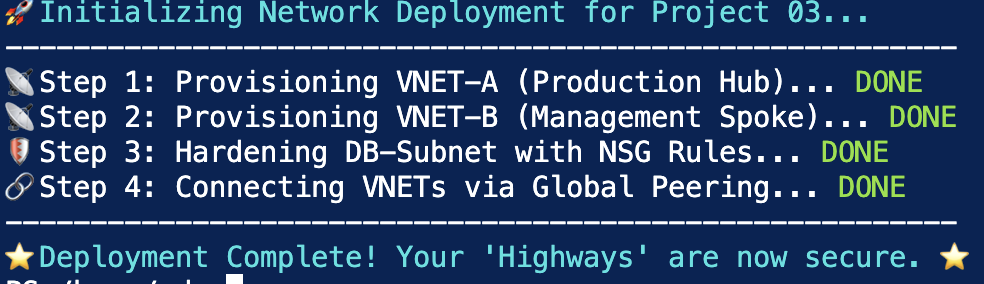
2. Private Connectivity (VNet Peering)
VNet peering was configured to allow private communication between networks without exposure to the public internet.
- Uses Microsoft backbone
- Low latency and secure
- Eliminates need for public endpoints

3. Network Security Enforcement (NSGs)
Network Security Groups were applied to enforce strict inbound traffic rules.
Example Rule Set
- Allow HTTPS (443) from public sources
- Restrict SSH (22) to management subnet only
- Deny all other inbound traffic
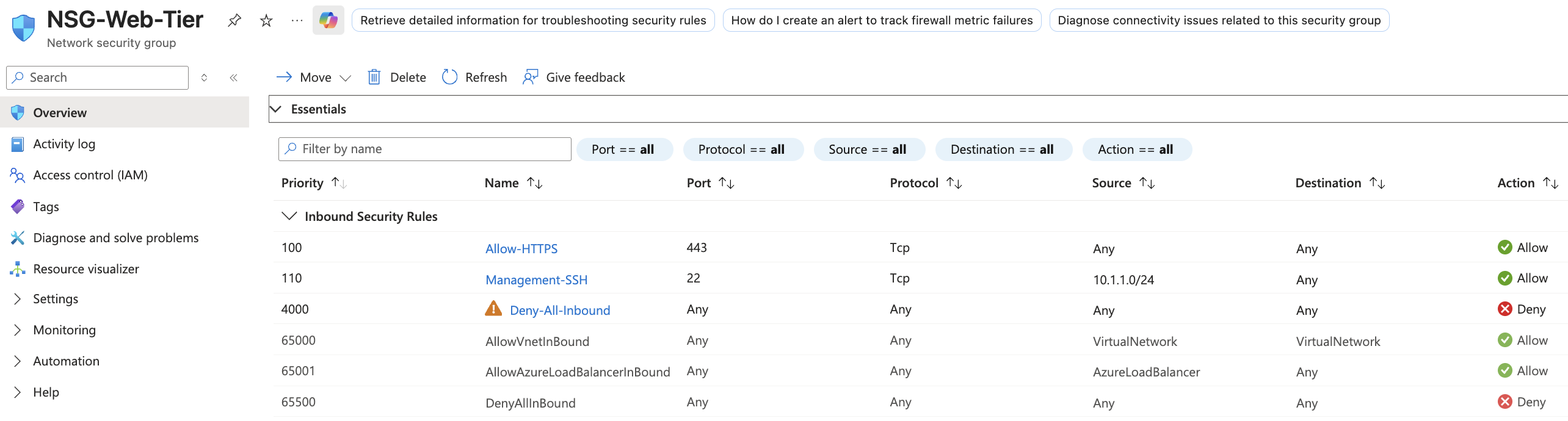
Enforces least privilege at the network layer.
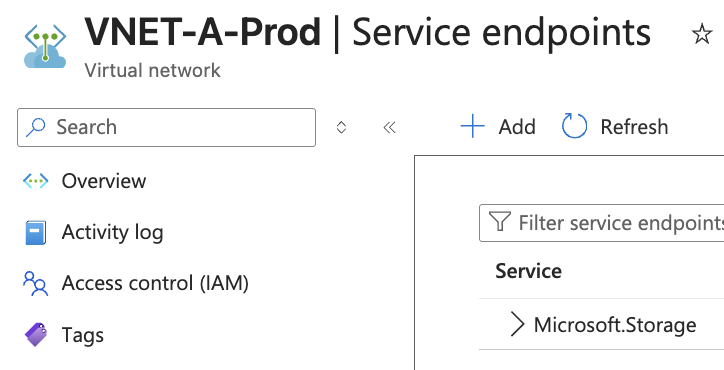
4. Data Access Restriction (Service Endpoints)
Storage access was restricted to trusted subnets using service endpoints.
- Prevents access from external networks
- Ensures data is only accessible from approved workloads
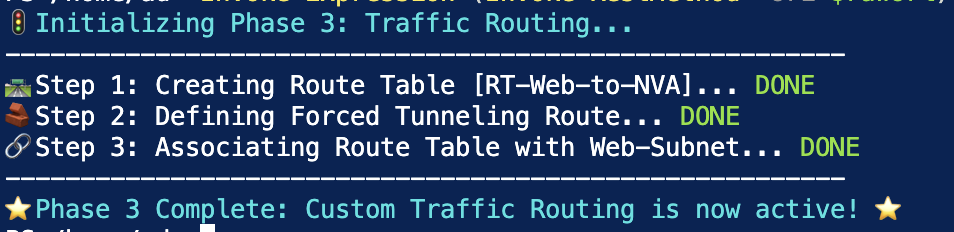
5. Traffic Control (User-Defined Routes)
Custom routing was implemented to control how traffic flows between subnets.
- Internet-bound traffic redirected to defined next hop
- Supports integration with firewalls or NVAs
- Overrides default Azure routing behaviour
⚖️ Design Considerations & Trade-offs
- Segmentation improves security but increases complexity
- Strict NSG rules reduce risk but require ongoing management
- Custom routing enables control but adds operational overhead
- Private connectivity improves security but requires planning of address space
🎯 Outcome
This project demonstrates how network design contributes to secure cloud environments through:
- Segmented infrastructure
- Controlled communication paths
- Enforced traffic restrictions
- Integration with identity-based access control
🧠 Key Outcomes
- Reduced Attack Surface: Limited exposure through strict inbound rules
- Controlled Access: Enforced communication only between authorised components
- Improved Security Posture: Combined network and identity controls
- Scalable Design: Structured architecture supporting future growth
🔮 Future Enhancements
- Integration with Azure Firewall or Network Virtual Appliance (NVA)
- Implementation of Private Endpoints for storage and services
- Automated network policy deployment via CI/CD pipelines
Maintained by Jacob Adedoyin