🏛️ Project 01: Identity Governance & Resource Control




🎯 Objective
Design and implement a governance model that enforces controlled access, accountability, and protection of cloud resources, reducing the risk of unauthorised or accidental changes.
This project demonstrates how governance controls support Identity and Access Management (IAM) by ensuring resource access is structured, auditable, and aligned to least privilege principles.
🧠 Design Rationale
The governance model is applied at the resource group level to enforce consistency, simplify access control, and ensure inheritance across all contained resources.
- Identity Accountability: Tagging strategy links resources to accountable owners, supporting access governance and auditability
- Defence in Depth: Resource locks provide a control layer beyond RBAC, preventing destructive actions even when permissions allow
- Scalability: Group-level controls reduce administrative overhead and enforce consistent governance across environments
- Automation: PowerShell used to eliminate manual configuration risk and enable repeatable governance enforcement
This reflects a shift from permission-only control to layered governance, combining identity, access, and resource protection.
🔐 IAM & Governance Alignment
This implementation supports key IAM principles:
- Least Privilege: Restricts ability to delete or modify resources beyond intended access
- Accountability: Maps resources to identifiable owners via tagging
- Defence in Depth: Combines RBAC with resource-level controls
- Auditability: Ensures ownership and control decisions are visible and traceable
🛠️ Technical Stack
| Category | Tools Used | IAM / Security Relevance |
|---|---|---|
| Cloud Platform | Microsoft Azure | Identity-integrated resource management |
| Identity & Access | Microsoft Entra ID, RBAC | Access control and permission enforcement |
| Governance | Azure Policy | Automated compliance and standard enforcement |
| Security | Resource Locks | Protection beyond permission-based controls |
| Automation | PowerShell, Azure CLI | Consistent application of governance controls |
📌 Implementation
1. Resource Tagging & Identity Accountability
A standardised tagging taxonomy was implemented at the resource group level to ensure resources are linked to identifiable owners and environments.
Tagging Strategy
- Environment: separates production and non-production access boundaries
- AccountableParty: identifies responsible owner for access and operational management

Tagging supports identity governance by linking resources to accountable individuals and enabling traceability.
2. Resource Locks & Access Control Guardrails
A PowerShell script (apply-group-lock.ps1) was used to apply a CanNotDelete lock at the resource group level.
IAM Relevance
- Prevents destructive actions even when permissions allow it
- Adds a secondary control layer beyond RBAC
- Reduces risk from misconfigured or over-privileged access

3. Validation: Control Enforcement
Deletion attempts at both:
- Resource Group level
- Individual resource level
were blocked by Azure Resource Manager due to lock inheritance.
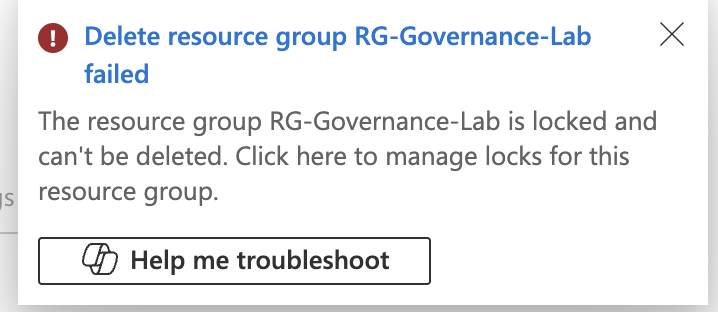
Demonstrates enforcement of governance controls independent of user permissions.
⚖️ Design Considerations & Trade-offs
- Applying locks at group level improves security but reduces operational flexibility
- Tagging requires consistent enforcement; without policy validation, accuracy can degrade
- Governance controls must balance security, usability, and operational efficiency
🎯 Outcome
This project demonstrates how governance controls extend IAM beyond permissions by introducing structured, enforceable controls that:
- Reduce risk of accidental or unauthorised actions
- Improve accountability and ownership visibility
- Support scalable access governance in cloud environments